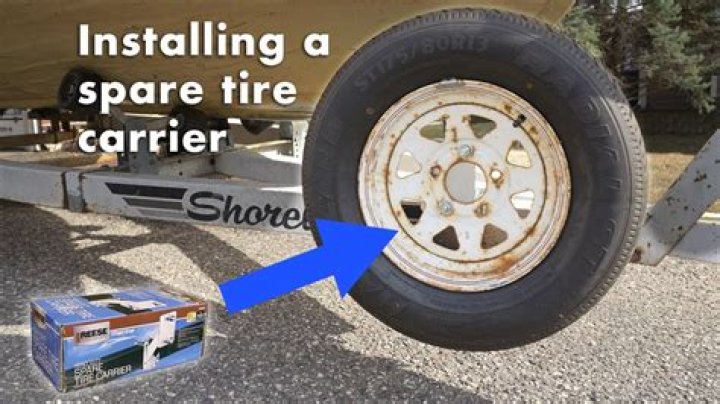
Simply so, what happens if you put a spare tire on backwards?
Take the spare tire and line up the wheel studs and the holes on the rim of the spare tire. Put the lug nuts on the wheel studs tighten by hand. Be cautious not to put the spare on backwards. It can damage your vehicle.
Similarly, how long can you ride around on a spare tire? A general rule of thumb is to drive no more than 70 miles and no faster than 50 miles per hour before replacing your donut with a new tire. The biggest reason to use these space savers for a short period of time is because they have little to no tread. This makes the spare vulnerable to road hazards and projectiles.
In this way, where do you put the spare tire?
Be sure to install the spare tire the correct way and not backwards. The valve stem of a doughnut tire should face outwards, away from the vehicle. If your vehicle uses acorn-style lug nuts, it is easy to put those on backwards as well. Be sure the tapered part of the nut faces the wheel when tightening it down.
Is a spare tire a safety feature?
Not so long ago, nearly every car came with a full-size spare tire, according to Sinclair. But in recent years, fuel economy requirements have prompted automakers to start offering smaller, temporary spares, and in some vehicles, no spares at all. He said a car with no spare is a safety hazard.
Related Question Answers
Can you put air in a spare tire?
A matching full-size spare is just like the tires you are using on your vehicle. These should be inflated with the same air pressure as your running tires. In fact, they should be incorporated in with the tire rotation, so that they wear out evenly along with your regular tires.Can you change a tire without a jack?
But without a jack, it's best to do the work somewhere pliable and soft. Turn your car off and engage your emergency brake fully. First, find something you can use as a blocking tool to slide under the side of the axle closest to the flat tire. With enough room to work, remove the nuts on the tire with a tire iron.How far can you go on a flat tire?
The flat tire "acts as a cushion," according to Car Talk, protecting the rim of the wheel. You can therefore drive — again, at a slow speed — for hundreds of yards before your wheel is damaged, "though your tire may no longer be any good."Can you change a tire with the emergency brake on?
As a result, it can roll forward, backward, or even slide off of the jack. When changing a tire, always set the emergency brake and block the tires with rocks or blocks to keep the vehicle from rolling. Typically, you'll want to block the tire opposite of the flat tire, explainsedmunds.com.When should you replace car tires?
Ten years is a maximum. If the tires haven't been replaced 10 years after their date of manufacture, as a precaution, Michelin recommends replacing them with new tires. Even if they appear to be in usable condition and have not worn down to the tread wear indicator.Can a donut tire go flat?
If you use the spare tire for too long, there is a good chance it will end up flat. In fact, you should only use the spare to drive for about 50 miles at most.Should a spare tire be in the front or back?
As you can see, you want to avoid driving your front wheel drive vehicle with a small, spare tire in the front or you could risk ruining your transmission. If you do get a flat tire in one of the front tires, rotate one of the good tires from the back axle up to replace the flat tire.How long will a donut tire last?
Donut tires are only meant to be temporary fixes for a flat tire until you can safety reach a Chicago area service center to get your tire replaced. In general, most donuts should not be driven on for longer than 50-70 miles.Can I put regular tires instead of run flats?
If you decide you want to replace the run-flats that came on your car with standard tires, it's perfectly fine to mount them on your existing wheels. They'll fit properly so as long as they're the same size.Does spare tire size matter?
Yes, you can use your old tire as a spare, as the general rule is that a spare within 2" of the bad tire on the ground will work, but a used tire the same size as your tires on the ground won't cost much.Can I drive 5 miles on a flat tire?
To be safe, driving on a flat tire at all is too far. If your tire has lost all air pressure, it not only will damage the tire beyond the possibility of repair, but can put you in harm's way. If you choose to drive it to the shop, stop every mile or so to check the tire's pressure.Is a spare tire the same as a donut?
Spare tires are full-size tires that are the same size as your existing tires. On the other hand, donuts are a temporary spare tire . They are much smaller than your regular tires and are only meant for short distances until you can get a new full-sized tire.How much does a spare tire cost?
Spare tire prices vary greatly depending on the type of spare you purchase, and often start at $100 and go up. A full-size matching spare generally costs more than twice that of a compact temporary. Some donut tires can be purchased online for as low as $50, but are more expensive at a tire retailer.What happens if you drive on a spare tire too long?
Temporary, donut spare tires are not designed for long-range service. They are made to get you to a garage to have your tire either repaired or replaced. Driving on it for an extended period of time under regular driving conditions will result in a blowout in short order, so get a safe tire on your car immediately.Why do truck tires explode?
A number of conditions will cause a worn or defective tire to be under sudden pressure or an impact that causes it to explode or lose air pressure quickly, with a truck tire blowout being the result. Some of these factors include: Wear and tear of the tire, which can result in a blowout if the tire is not replaced.Why spare wheel is smaller?
The reasons your vehicle's spare tire is so differentdesigned to take up less space than a normal tire would when stored in the trunk. made to minimize the extra weight put on the car when carried. not intended for long-term use like standard tires. intended to travel less than 100 miles and under 50 mph.